
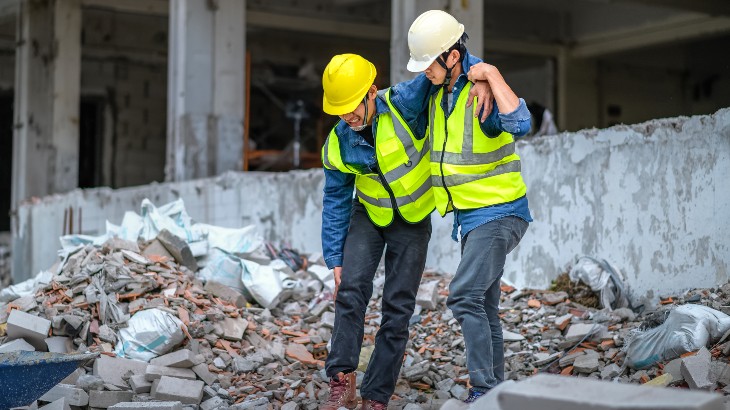
A construction accident often creates two separate legal claims at once: a workers' compensation claim against your employer and a personal injury claim against whoever caused the accident. Most injured construction workers only file the comp claim.
Workers' compensation pays medical costs and a portion of lost wages no matter who caused your accident. However, it does not compensate you for pain and suffering, and it does not cover the full value of a permanent injury.
When a general contractor, property owner, or equipment manufacturer shares fault for your accident, a separate lawsuit can recover what workers' comp leaves out. A Syracuse construction accident lawyer at MCV Law reviews both angles from the start, since missing the second claim could mean missing the larger recovery.
Call 315-471-1664 to have an attorney review your accident free of charge.
Contact Us for a Free Consultation
How MCV Law Handles Construction Accident Claims in Central New York
MCV Law represents construction workers hurt on job sites across Syracuse, Auburn, and Chittenango and all of Central New York. Our firm handles the workers' comp claim and the third-party injury claim together rather than referring one out.
That coordination matters because evidence from the accident scene often supports both cases, and a delay on one side can weaken the other.
Attorneys Alicia Loomis and Robert Taylor take construction accident calls themselves. Workers calling after a scaffold fall or an equipment injury talk to the person who will handle the case, not a screener.
Because site conditions change and equipment rapidly gets repaired or removed, construction cases move fast in the weeks following an accident. Getting an attorney involved early preserves evidence a later claim needs.
Can I File Both a Workers' Comp Claim and a Lawsuit After a Construction Accident?
Yes, New York law allows an injured construction worker to collect workers' compensation benefits and pursue a separate lawsuit against a third party for the same accident. The two claims run on different rules and compensate for different things, so neither one replaces the other.
Workers' compensation is a no-fault system, meaning you receive benefits regardless of who caused the accident, but the payout formula caps what you can recover.
| What's Covered | Workers' Compensation | Third-Party Lawsuit |
|---|---|---|
| Medical expenses | Yes, work-related treatment | Yes, full past and future costs |
| Lost wages | Partial, based on a formula | Full lost income and future earning loss |
| Pain and suffering | Not covered | Can be recovered |
| Fault required | No-fault legal basis | Depends on the claim, including negligence, statutory liability, or product liability |
| Who pays | Employer's insurance carrier | At-fault party's insurance or assets |
A worker hurt by a defective crane, an unsafe scaffold owned by a general contractor, or a subcontractor's negligence has both claims available.
Who Can Be Held Liable for a Construction Accident Besides Your Employer?
Several parties on a construction site carry legal responsibility for safety besides your direct employer, and any of them could be liable if their conduct contributed to your injury. New York job sites typically involve more companies than the worker on the ground ever interacts with directly.
Parties who commonly share liability in a Central New York construction accident include:
- General contractors responsible for overall site safety and coordination
- Property owners who control the site where the work took place
- Subcontractors whose crews or equipment created the hazard
- Equipment manufacturers when a tool or machine failed due to a defect
- Architects or engineers when a design flaw contributed to the accident
Identifying every liable party often requires a site investigation, review of contracts, analysis of the accident report itself, and experienced review. Workers rarely know who actually owned the defective scaffold or who hired the subcontractor whose crew left a hazard unmarked.
New York's Scaffold Law and Fall Protection Requirements
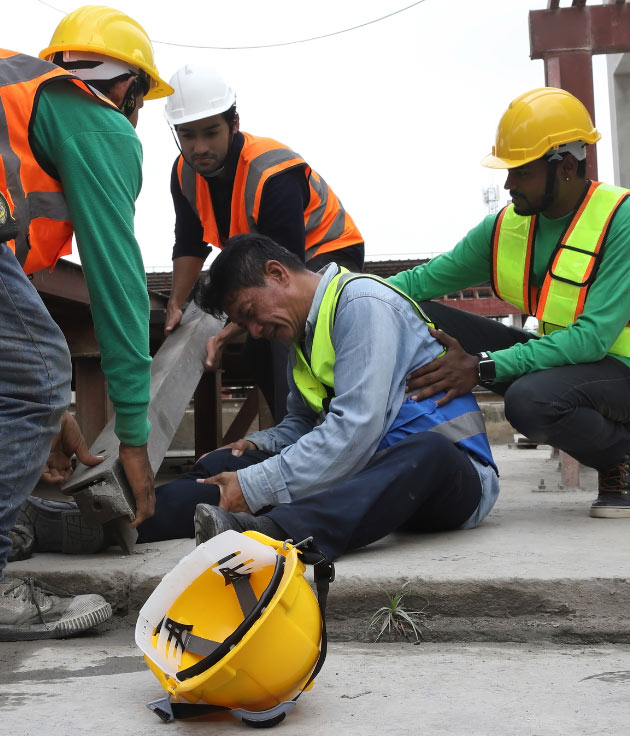
New York Labor Law § 240, known as the Scaffold Law, provides special protections for workers exposed to certain elevation-related risks during covered construction, demolition, repair, alteration, painting, cleaning, and pointing work.
Labor Law 240 requires contractors and owners to furnish safety equipment adequate to protect workers performing elevated work. Labor Law 241 adds further safety requirements specific to construction, excavation, and demolition sites.
Equipment covered under these sections includes:
- Scaffolding built and maintained to support the weight placed on it
- Ladders suited to the height and type of work being performed
- Hoists, pulleys, and slings used to move workers or materials
- Safety nets, harnesses, and other fall arrest systems
- Braces, irons, and ropes used to secure elevated work platforms
Falls remain the leading cause of death in construction nationwide, accounting for 389 of 1,034 construction fatalities in 2024, according to OSHA's fall prevention data. A missing harness or an unsecured ladder is not a minor oversight. It is often the exact failure these laws were written to prevent.
Common Causes of Construction Accidents in Central New York
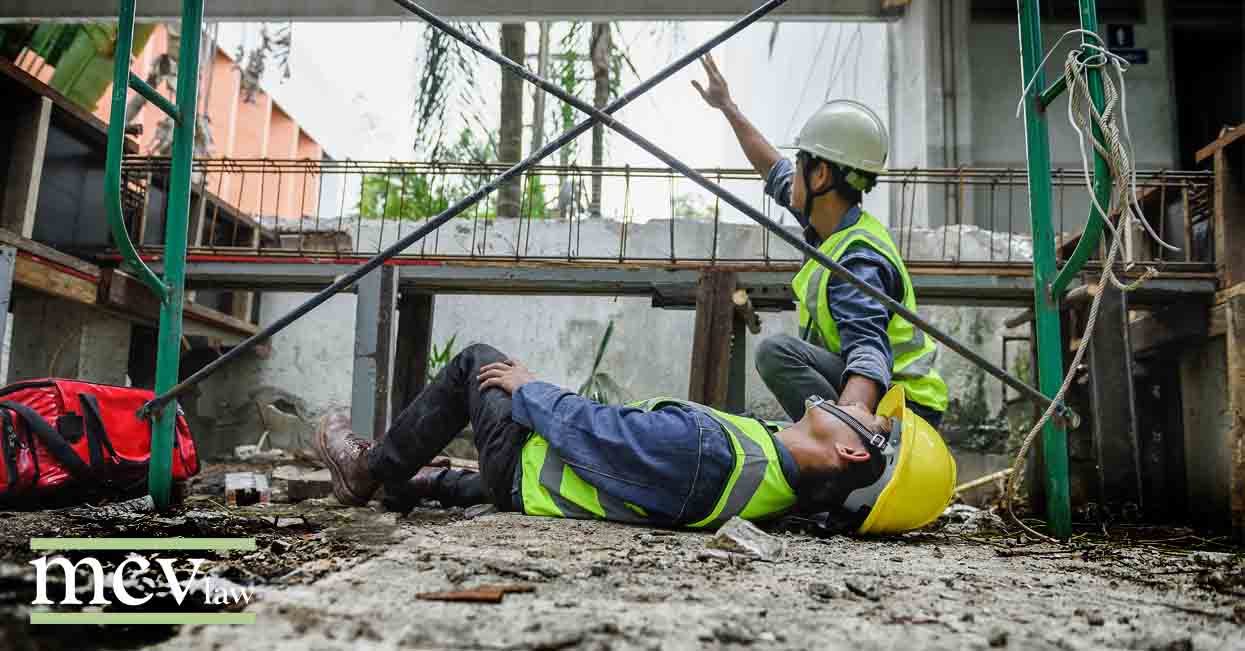
Construction accidents in Central New York typically stem from a few recurring hazards rather than unpredictable events. Winter weather, aging infrastructure on renovation projects, and multi-contractor coordination all raise the risk on local sites.
Construction Accident causes MCV Law sees most often include:
- Falls from scaffolding, roofs, ladders, or unprotected floor openings
- Scaffold or structural collapse due to improper assembly
- Being struck by falling tools, materials, or debris
- Equipment failure involving cranes, forklifts, or power tools
- Trench or excavation collapse on utility and foundation work
- Electrocution from contact with power lines or exposed wiring
Each of these hazards has a corresponding safety standard designed to prevent it. When an accident happens anyway, the gap between the standard and what actually occurred on-site becomes the basis for a claim.
What Should You Do After a Construction Accident on the Job?
Report your construction accident to your employer immediately and seek medical treatment before doing anything else. The actions you take in the first hours and days after a job site injury affects both your workers' comp claim and any third-party case tied to it.
After a construction accident, take these steps:
- Report the injury to your supervisor or employer in writing as soon as possible
- Immediately seek medical treatment and tell the provider the injury happened at work
- Photograph the accident scene, equipment involved, and any visible injuries
- Get names and contact information for coworkers who witnessed the accident
- Contact an attorney before giving a recorded statement to any insurance company
Insurance adjusters contact injured workers within days of an accident. An adjuster's job is to minimize what the insurance company pays, not to protect your claim.
Ask MCV Law: Construction Accident Questions From Central New York Workers
My employer says I can't sue because workers' comp covers me. Is that true?
Your employer is correct that you cannot sue directly, since workers' comp is the exclusive remedy against them. However, you may still be able to sue other parties, such as the general contractor or equipment manufacturer, whose negligence caused or contributed to your accident.
I was hurt by a subcontractor's equipment, not my own company's. Does workers' comp still apply?
Yes, workers' comp from your employer applies regardless of who caused the accident. A separate claim against the subcontractor or equipment owner could also be available for the same injury.
Can I lose my job for filing a workers' comp claim after a construction accident?
New York law prohibits employers from laying off workers in retaliation for filing a workers' comp claim. Report any retaliation to an attorney right away, since it may create a separate legal issue.
The general contractor says the accident was my fault. Does that end my case?
Not necessarily. New York's Scaffold Law imposes strict liability on contractors and owners for certain fall-related accidents regardless of some claims of worker fault, though the specific facts of your accident matter.
I already accepted a workers' comp settlement. Can I still file a third-party claim?
You may still have a third-party claim available, but a workers' comp settlement can affect how that recovery gets calculated. Talk to an attorney before accepting any offer tied to the same accident.
Do I need a lawyer if I already have a workers' comp claim open?
Yes, an attorney can identify whether a separate third-party claim exists even while your workers' comp case moves forward. Many construction workers never learn a second claim was available until it is too late to file.
What is the difference between a construction injury lawyer and a workers' comp lawyer?
A construction injury lawyer typically handles both the workers' comp claim and any third-party lawsuit tied to the same accident. A firm limited to workers' comp alone may miss the personal injury claim entirely.
Can I still file a claim if I was not wearing safety equipment when I fell?
If you were not wearing safety equipment because non was provided, or the provided equipment was defective, you may have a claim. New York's Scaffold Law places responsibility on contractors and owners to furnish adequate protection in the first place.
How much is my construction accident case worth?
Case value depends on the severity of your injuries, your total lost income, and whether a third-party claim is available in addition to workers' comp. An attorney can review your medical records, employment records, and accident details to assess your specific situation.
How Long Do You Have to File a Construction Accident Claim in New York?
Construction accident claims in New York run on different deadlines depending on which type of claim you are filing, and missing either one can end your case entirely. Workers' comp and third-party lawsuits do not share the same clock.
Key deadlines to know include:
- Notifying your employer of the injury within 30 days under New York's workers' comp filing rules
- Filing a workers' comp claim (Form C-3) within two years of the accident
- Filing a third-party personal injury lawsuit within three years under CPLR Section 214
- Serving a notice of claim within 90 days for claims against a municipality or other government entity.
That last deadline surprises many workers, since public infrastructure and school construction projects involve government entities more often than people expect. An attorney identifies which deadlines apply to your specific accident before any of them pass.
What Does It Cost to Hire a Construction Accident Lawyer?
A construction accident lawyer handling your third-party injury claim works on contingency, meaning you pay no fee unless the case results in a recovery.
Workers' compensation representation follows separate fee rules set by the Workers' Compensation Board, and any fee there requires board approval before it gets deducted from your award.
A contingency arrangement for your injury claim typically covers:
- Case investigation and evidence gathering at no upfront cost to you
- Court filing fees and expert witness costs advanced by the firm
- Negotiation with insurance companies on your behalf
- Trial representation if the case does not settle
- A fee taken only from the final recovery, and only if the case succeeds
Free consultations are available before you commit to anything. There is no fee unless the firm wins your case.
Get a Construction Accident Lawyer Reviewing Your Case Today
MCV Law handles construction accident cases throughout Central New York, including Auburn, Chittenango, and surrounding counties within the firm's service area. Office location does not limit where an accident can be reviewed.
Call 315-471-1664 for a free consultation with a construction accident lawyer at MCV Law. You speak directly with our lawyers.